


The Goodfellas' Smile Dominus: A Skin-Deep Shine


Average Result: DFS+
Composite Score: 26/40
The Goodfellas’ Smile Dominus is an unusual razor on several fronts, beginning with its material choice. Chrome-plated brass is not especially common in today’s artisan razor market, and TGS goes further by specifying the exact alloy: CW510L PB1, also known as CuZn42. This is a very low-lead brass with a high zinc content and roughly 57–59% copper, a material more often associated with plumbing and fittings than premium safety razors. TGS appears to be emphasizing the environmental angle, noting the alloy’s extremely low lead content of around 0.1%.
The Dominus is billed as 100% CNC-machined and then chrome-plated. Chrome plating is more often associated with zamak razors, but it makes sense here as a protective layer over brass, helping prevent tarnish and corrosion as long as the plating remains intact. The result is a razor with crisp lines and noticeably better tolerances than a die-cast zamak razor, though it still feels just shy of the precision normally associated with uncoated CNC-machined stainless steel or titanium. At 101 grams, the Dominus has satisfying heft and feels nicely balanced.
Architecturally, the Dominus falls into ShaveSplash’s Hybrid category, with a Clamp Width of 13mm. Hybrids sit between classic Blade Benders and Edge Clampers, using some degree of blade curvature while still leaving a meaningful portion of the blade unsupported near the edge. This category tends to produce lower Composite Scores than the more clearly defined classes, and the Dominus largely follows that pattern.
Dominus Has a Hybrid Architecture
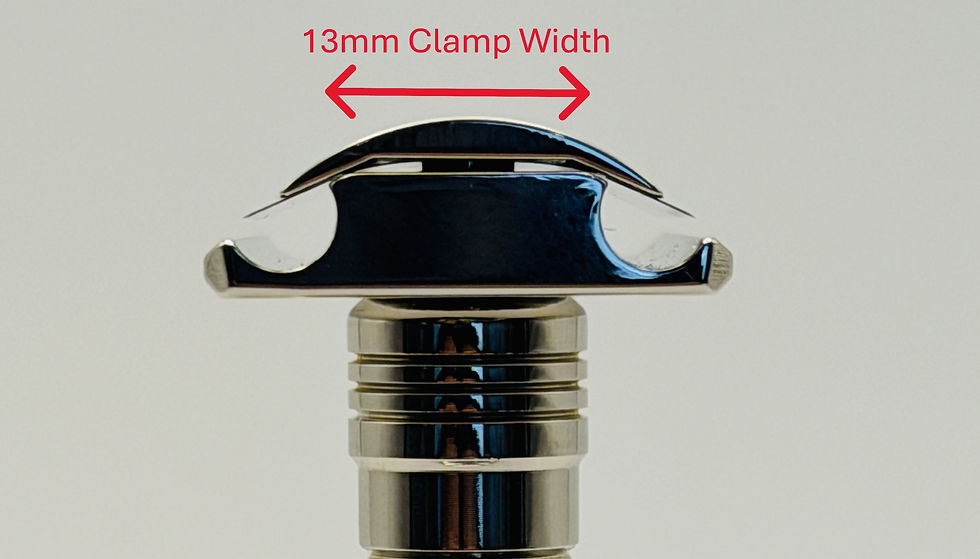
Its most striking design choice is the very narrow top cap. At only 17.5mm wide, it leaves a pronounced Blade Reveal of 2.25mm on each side. The stated Blade Exposure is extremely high at 0.25mm, a level rarely seen in modern safety razors. That positive exposure is visible to the naked eye and can be confirmed by running a thin piece of cardboard along the shave plane. The Blade Gap is also large at 0.85mm, putting both of its major blade specs in the zone normally associated with high efficiency. Interestingly, despite the wasp-stinger reveal, jutting exposure, and formidable gap, blade feel is only moderate. That is likely because so much of the blade is unsupported by the narrow top cap and modest clamp width, allowing the blade to flex rather than present itself as a rigid edge.

Unfortunately, that noticeable blade flex is also what holds the Dominus back. While it helps cushion the exposure against the face, it also reduces cutting authority and can introduce discomfort. Because so much of the blade is revealed and unsupported, the razor performs best at a shallow angle, slightly below the roughly 30-degree angle many consider neutral. The motion feels almost like pushing the blade edge forward in a subtle scything action, trying to keep the edge stable as it cuts. With this technique, a sharp blade is preferred because more of the cutting power needs to come from the blade edge rather than its motion.
Because of the flex and the slightly tricky shallow posture required, both Consistency and Ease of Use suffer. Despite the large 0.85mm Blade Gap and 0.25mm Blade Exposure, raw efficiency is held back by the clearly apparent blade flutter. The end result was on the lower side for ShaveSplash, finishing at DFS+.
Another unusual design choice is that the blade posts are located on the baseplate rather than the top cap. Although the posts are oblong, which should improve blade stability once everything is tightened down, placing them on the baseplate makes blade loading less intuitive. TGS has not explained this choice, but it may relate to the top cap’s extremely light and thin construction. At only 9 grams, the cap may have been designed more as a thin clamping shell than as a structural alignment piece, leaving the baseplate to handle blade alignment. The baseplate is also blind, with no cutouts or lather channels. That is another atypical choice, though in practice lather flow was adequate and there were no obvious signs of clogging.

The razor most similar to the Dominus is the little-known but excellent Rocnel 304. Like the Dominus, the 304 is an odd duck, with a 12mm Clamp Width and an enormous 2.5mm Blade Reveal, the largest ShaveSplash has tested. This is due to its similarly slender 17mm top cap. Where the 304 differs is in its wider 25mm baseplate and noticeably lower blade exposure. Interestingly, the 304 also uses a blind baseplate. The magic of the 304 is that its wider baseplate elongates the shave plane and, somewhat unintuitively, protects the skin from blade flex by keeping exposure low. The result is low efficiency, even lower than the Dominus, but with exceptionally high Comfort and Ease of Use. In fact, the Rocnel 304 remains a ShaveSplash favorite.
If nothing else, the Dominus is an interesting razor. The handle is grippy and well sized at 90mm, the overall build quality is satisfying, and at its price point it feels like a good value. It brings an unusual material, unusual architecture, and a genuinely distinctive shave character. But in a direct comparison with the Rocnel 304, ShaveSplash would choose the latter. The Dominus is more assertive and more technically curious, but the 304 turns its odd geometry into a smoother, easier, and more enjoyable shave.


ShaveSplash uses a Personna GEM Diamond Glide blade for all its testing and performs a traditional 3-pass shave. To learn more about our testing methods see here.

A useful review, as always.