


Yaqi Bohemia: The Blade Whale

Updated: Sep 8

Average Result: BBS/BBS- Composite Score: 31/40
The story of the Yaqi Bohemia, inspired by the Bohin razor, begins in 1833 in Normandy, France, where Benjamin Bohin established the Bohin metalworks. After a century spent producing mainly needles and pins, Bohin turned its attention to the shaving market in the 1930s. But the real prize was not razors. It was blades.

The Bohin Company Established in 1833
By 1918, Gillette was selling more than 30 million blades per year, a market that must have looked especially attractive to a company built around precision metalworking. To support its move into blades, Bohin filed a patent in 1936 for a proprietary razor design, published the following year. Rather than trying to reinvent the market, Bohin hoped to enter it with something familiar but improved. The razor accepted the standard three hole blade popularized by Gillette, while introducing a number of unusual design ideas of its own. Even the patent title was direct: “An Improved Safety Razor.” The razor appears to have been produced for roughly five to ten years and is now highly prized by collectors. Whether it truly improved upon Gillette’s design is open to debate. What is clear is that Bohin made several bold choices that were both technically adventurous and aesthetically distinctive.

The most innovative aspect of the Bohin was its reversible base plate, which ranks among the earliest, and possibly the very first, of its kind. Each side offered a different level of efficiency, described as “close shave” and “very close shave,” although no published specifications for blade gap or exposure appear to have survived. To make the plate easily reversible, the design remained symmetrical on both sides, and that requirement may also have driven its most visually striking feature: the large, bulbous comb. It is so pronounced that it resembles the baleen of a blue whale.

Open combs are generally intended to increase interaction between the blade and the skin while still providing a degree of protection. The tradeoff is usually greater raw efficiency at some cost to comfort. On most razors, the vertical height of the comb is modest, often around 1 to 2 mm, roughly the depth of a typical base plate. The extraordinary feature of the Bohemia is that its comb rises to an extremely tall 7 mm, creating a tremendous amount of surface area between the razor and the face. The base plate is also unusually wide at 26 mm, compared with roughly 25 mm for many conventional designs, which again keeps the blade farther from the skin. The result is a highly protective geometry, but one that comes with a price. The broad plate and towering comb narrow the usable cutting angle, making the optimal angle of attack somewhat tricky to find and maintain.

Another defining characteristic of the Bohemia is its heft. At 131g, it feels impressively substantial in the hand. Its mass and density give it a planted, sure footed feel and allow the razor to do much of the work on a typical downward WTG pass. At the same time, that bulk can make it feel somewhat unwieldy, especially when trying to stay within its relatively narrow range of effective cutting angles.
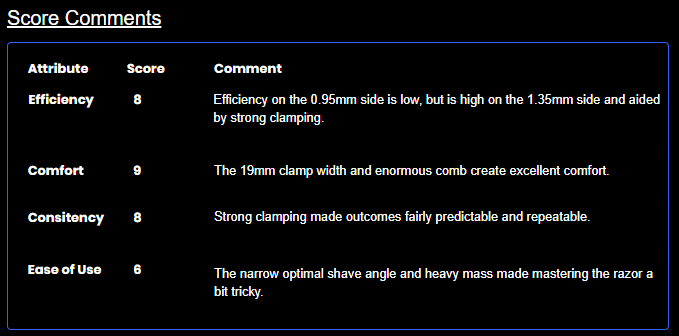
On the 0.95 mm side, efficiency is fairly modest, landing in the region of a 5 or 6 and generally producing results in the DFS+ range. Flip the plate to 1.35 mm, however, and the character changes noticeably, with efficiency rising to an 8. Unlike many designs of the period that fall into the Hybrid category, with clamp widths around 12 mm such as the Merkur 34, Bohin appears to have understood the benefits of a much wider clamp. Perhaps reflecting its metalworking DNA and understanding of metallurgy, Bohin chose a substantial 19 mm clamp width, making the design a strong Edge Clamper by ShaveSplash classification. The result is excellent blade rigidity, which, together with the protective comb and broad base plate, makes Comfort its strongest attribute at 9. The comb, however, is also something of an impediment. Combined with the razor’s girth and narrow cutting window, it makes angle control more demanding and drops Ease of Use to its weakest score of 6. Repeated shaves proved fairly predictable, with Consistency earning an 8 and bringing the Overall Composite Score to 31, squarely in premium razor territory. As for outcomes, a standard three pass WTG, XTG, and ATG shave with a Personna Diamond Gem delivered a respectable BBS/BBS- result, worthy of virtually any occasion, with strong supporting scores outside of Ease of Use.

Despite its quirks, in the eyes of ShaveSplash, the Bohemia and its progenitor, the Bohin, are gems. Bohin occupies a fascinating place in the history of wet shaving, with the company surviving and thriving today even though its razor did not. Yet what makes the design most compelling is its unmistakable French Art Deco elegance. Its curves, proportions, and eye-catching base plate crystallize a moment when wet shaving and men’s grooming were closely associated with cultivation, refinement, and sophistication. Ultimately, it is that beauty, as much as the engineering beneath it, that makes the Bohemia so intriguing and so worthy of a place in the enthusiast’s collection.


Comments